
Entity Authority • Section Hub
Entity Authority
Entity authority is how search and AI come to recognize a brand as one trusted entity, and decide what it is authoritative for. This section shows how those signals are built and read: schema, sameAs, disambiguation and the machine-readable trust layer.
How do search and AI know my brand is who it says it is?
Entity authority is how search and AI recognize a brand as a distinct entity and judge what it is authoritative for. It is built from consistent identity signals that engines read to disambiguate and cite. This section shows the mechanism; the strategy of why authority fails to transfer abroad is answered on gason-marketing.com.
Why does AI confuse my brand with another company abroad?
Because the same name can exist in several markets, and the signals that tell them apart are often weaker outside your home market. An engine distinguishes brands using structured data on the site, consistent naming and details, sameAs links, knowledge-base entries, and what the brand is mentioned alongside in third-party sources. Where those signals are thin in a market, which is common abroad, the engine merges the two or mixes them up. Consistent identity signals, corroborated market by market, are what resolve it.
Do unlinked brand mentions actually help?
Yes, often more than backlinks. Engines read consistent, unlinked mentions as evidence of who a brand is and what it is known for, where a link mostly votes for a page. Co-occurrence with the right topics, in credible places, is what builds the entity. The mention doesn’t need to link to count.
Is entity authority an SEO task or an AI-strategy task?
Both, and the framing decides the priority. Treated as classic SEO, schema, sameAs links and consistent mentions look like housekeeping; treated as AI-citation infrastructure, they are how an engine decides whether to name you at all. The work is the same, but the stakes are higher once you see it as what makes the brand citable.
Where do entity signals actually get built?
In the places an engine already trusts to describe entities: a consistent canonical profile, structured data that agrees with it, knowledge bases, registries and corroborating mentions across credible sources. The point is convergence: every place that names the brand should agree on the same facts, so the engine resolves one confident entity rather than several uncertain ones.
What this section shows
The Entity Authority cornerstones
Each guide isolates one mechanism.
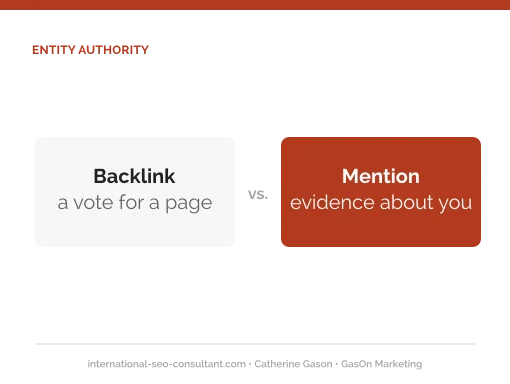
How AI reads brand mentions as entity signals
For an engine that resolves entities, a consistent unlinked mention still says who a brand is.
Read → Entity Signals • Brand Mentions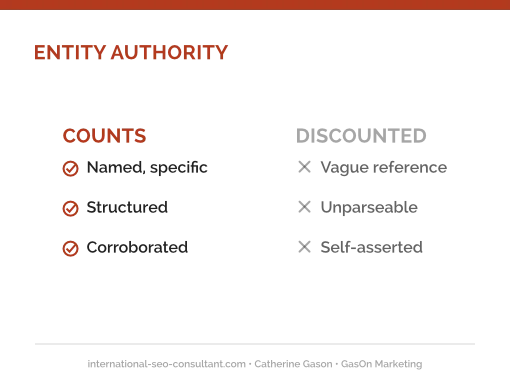
What counts as a citation to an AI engine
Being named is not being counted; a mention counts only when it is specific, parseable and corroborated.
Read → AI Citations • DefinitionRelated questions
The adjacent questions that come up next: each answered on its own page.
Why does entity work matter for AI answers?
Recognition and corroboration are two of the four gates an engine runs before naming a brand. Without a resolved entity, strong pages still don’t get cited.
AI Visibility →Does entity authority carry across languages and markets?
Not by default. Each market version has to resolve to the same entity, which is where hreflang, architecture and cross-language signals meet entity work.
International SEO →Do entity signals matter beyond Google?
Yes. AI answers, marketplaces and social platforms all need to know which brand they are looking at, and consistent identity is what ties the mentions together on each surface.
Search Everywhere →How consistent is our entity across markets today?
An audit maps schema, sameAs links, naming and third-party mentions market by market, and shows where the identity splits.
The International SEO & AI Visibility Audit on gason-marketing.com →