
Search Everywhere Optimization • Mechanism
How to measure international visibility, market by market
Entering a new market drags down a global visibility score, because the new market starts at zero. Scored market by market, existing markets keep their scores and the new one gets its own.
How do you measure international visibility without hiding the gaps?
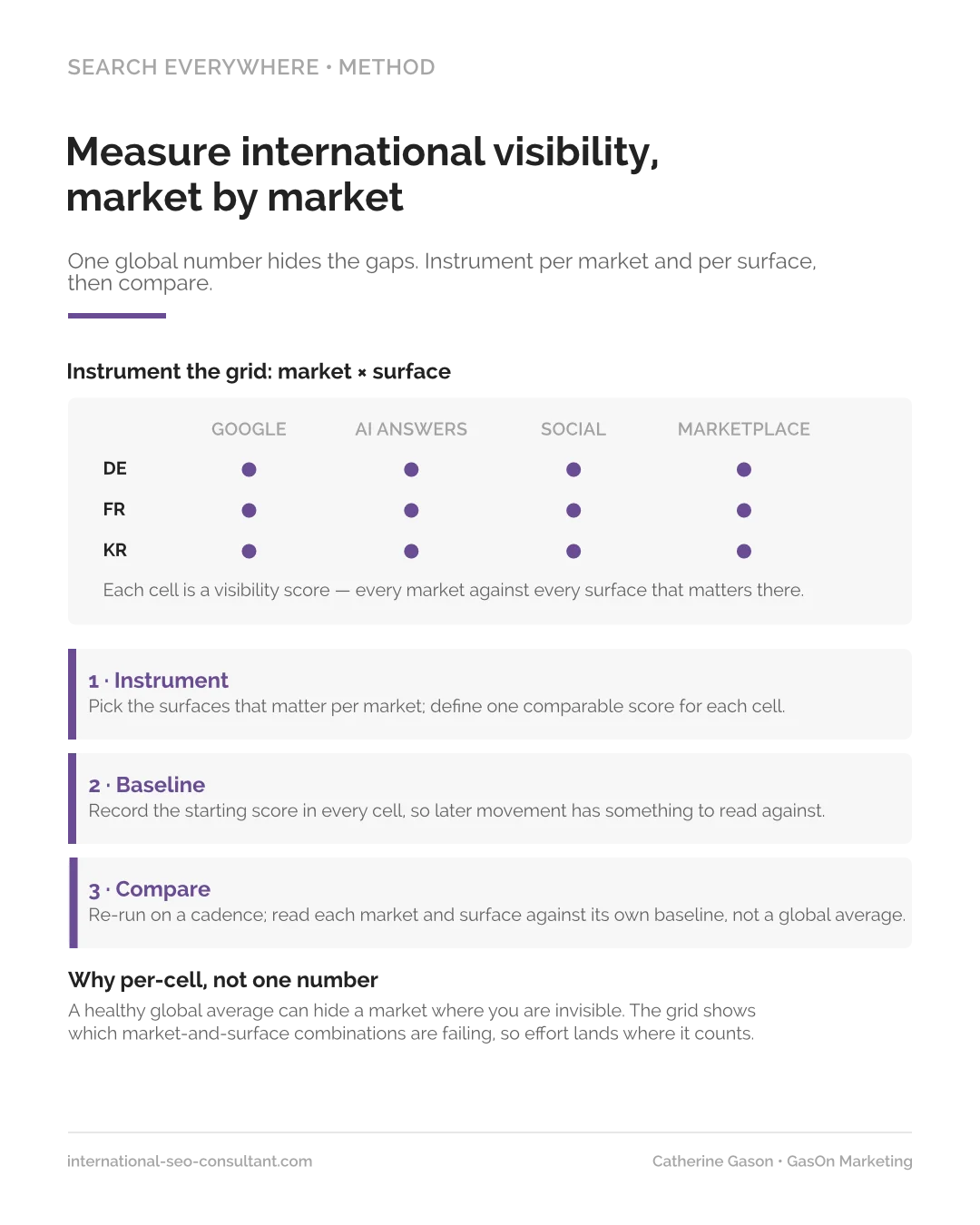
Score each market separately, by location rather than language, and within each market score every place buyers search: Google, AI answers, social platforms, marketplaces. Record where each score starts, re-check on a fixed interval, and compare each score with its own history. A worldwide average hides the market that is failing.
Instrument
Pick the surfaces per market
In Germany that may be Google and Amazon; in South Korea, Naver and a local marketplace. Give each country-and-surface pair one score you can repeat.
Baseline
Record where every score starts
Take the first reading in every cell before you change anything, and record a competitor in the same cell at the same time.
Compare
Read each score against its own start
Re-score on a fixed interval and judge each cell against its own history, never against a global average or against another market.
The mechanism, in detail
Why is a single global visibility number misleading?
A blended figure lets strong markets cover weak ones, and the tools that produce it usually omit the zeros. A rank tracker reports nothing for terms you don’t rank for, and an AI answer that doesn’t mention you leaves nothing to record. So the average only covers the places where you already appear; the markets where you are absent drop out of it.
What exactly do you score in each market?
You score each place buyers search, in each market, by location rather than by language. The same German query returns a different result set in Germany and in Austria, so a German-language score isn’t a Germany score. Each cell is one country and one surface: Google in Germany, Naver in South Korea, the marketplace that matters in each.
How will I know whether a change actually worked?
A starting score on its own won’t show it, because platforms change independently of your work. When Naver adjusts how it blends results, scores across that surface move together. Record a competitor’s score in the same cell at the same time as your own. If both scores rise, the change came from the surface. If only yours rises, it came from your work.
Should a weak market be compared with a strong one?
No. Apart from starting in different places, the scores don’t measure the same thing: a citation rate built from eight real buyer questions doesn’t mean the same as one built from fifty in a mature market. Compare each cell with its own history, and don’t roll the grid into a single index, which brings back the blended figure.
How often should the grid be re-scored?
Different cells need different intervals. An AI cell only means something across several runs, so it is re-scored in batches; a ranking cell can be checked weekly or monthly. Keep each interval fixed, because scores taken at irregular intervals can’t be read as a trend. Review the grid itself once or twice a year. If buyers in a market have moved to a marketplace or a local engine, a grid still scoring last year’s surfaces shows stable numbers for a market that has changed.
More in Search Everywhere Optimization
The other guides in this section, each answering its own question.

Search Everywhere Optimization: a practical guide
Buyers no longer search in one box, and each surface rewards something different.
Read Search Everywhere • Strategy
Naver SEO: how South Korea’s search engine works
In South Korea, a Google-only playbook fails because discovery lives inside Naver’s own ecosystem.
Read Naver SEO • South Korea