
AI Visibility · Mechanism
How AI engines choose which brands to cite
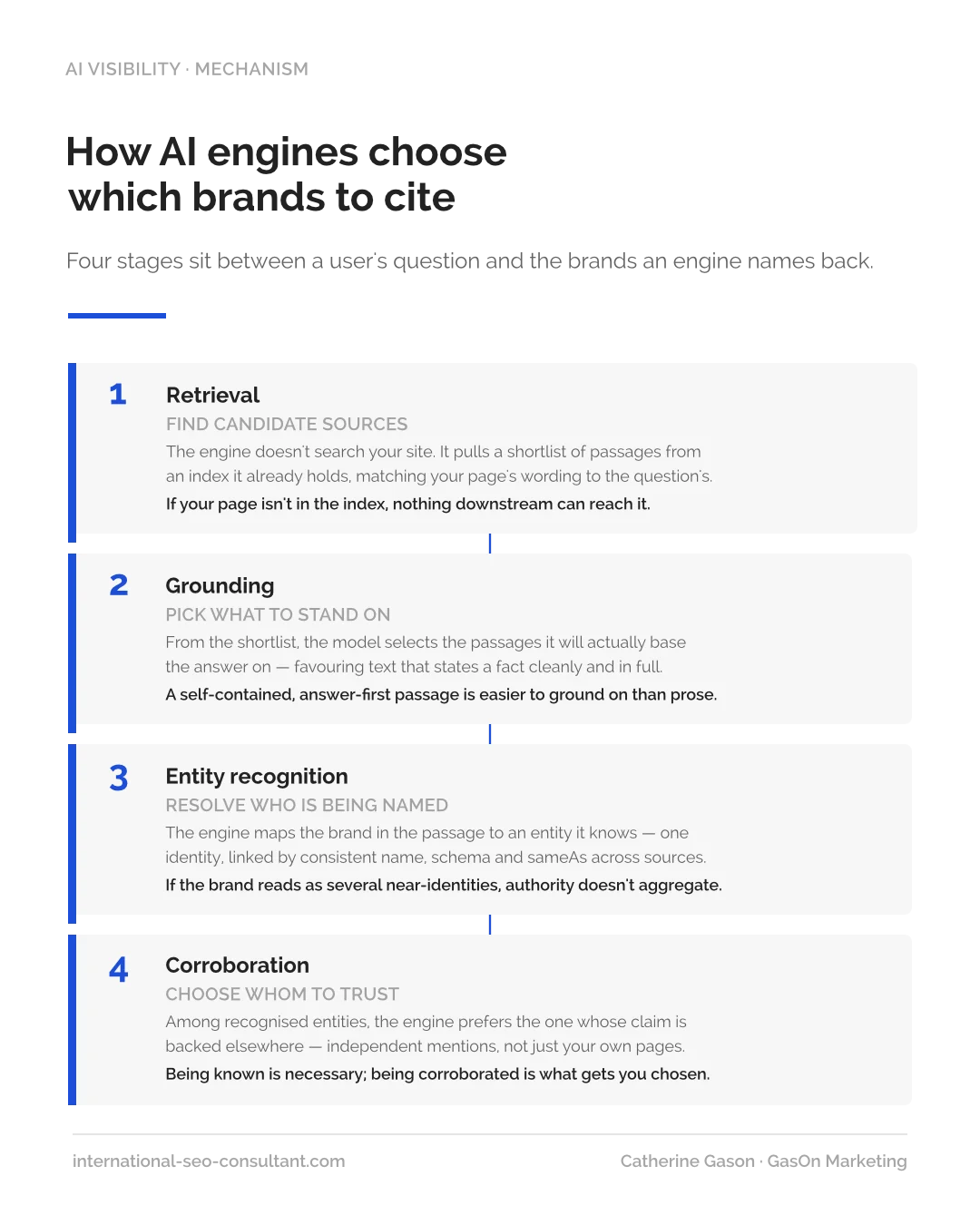
Before an engine names any brand, a user’s question passes through four decision points, and a brand can fall out at any one of them. This is where, and why.
What decides whether an AI engine cites your brand?
AI engines choose which brands to cite in four stages: retrieval pulls candidate passages from an index, grounding selects the ones the answer stands on, entity recognition resolves which brand is named and corroboration prefers the entity backed by independent sources. A brand that fails at any one of them falls out, however strong its own pages.
Retrieval
Finds the candidate sources
The engine doesn't search your site. It pulls a shortlist of passages from an index it already holds, matching your page's wording to the questions. If your page isn't in that index, nothing downstream can reach it.
Grounding
Picks what the answer stands on
From the shortlist, the model selects the passages it will actually base the answer on, favoring text that states a fact cleanly and in full. A self-contained, answer-first passage is easier to ground on than the same fact spread across several paragraphs.
Entity recognition
Works out who is being named
The engine maps the brand in the passage to an entity it already knows: one identity, held together by consistent naming, matching details across records and the entities it is repeatedly named alongside. If the brand reads as several near-identities, authority doesn't aggregate.
Corroboration
Decides whom to trust
Among the entities it recognizes, the engine prefers the one whose claim is backed elsewhere: independent mentions beyond your own pages. Being known is necessary; being corroborated is what gets you chosen.
The mechanism, in detail
Does the engine search your website when it answers?
No. The engine answers from an index it already holds, not a live crawl of your site. It retrieves a shortlist of passages whose wording matches the question, then works only from that shortlist. A page missing from the index — blocked, unindexed or too new — can't be reached by anything that follows, so indexation is the first gate.
Where does the index an engine reads from come from?
It depends on the engine. Some query a live web index, their own or a partner's; others crawl the web themselves. Separately, the model carries a training snapshot fixed months earlier. A page can sit in one and not the other, which is why citation often lags publication.
Why does answer-first phrasing get cited more often?
Grounding is where the model chooses which retrieved passages the answer will stand on. It favors text that states a fact cleanly, in one place. A passage that answers in its first 40–60 words and stands alone if lifted is easier to ground on than the same fact assembled from several paragraphs.
What does entity recognition change about citation?
Entity recognition maps the brand in a passage to one identity the engine already knows, assembled from consistent naming, matching details across records and the entities it is repeatedly named alongside. When a brand reads as one entity, every mention compounds onto it. When it reads as several near-identities across markets and languages, authority fragments and no profile clears the bar.
Why isn't being recognized enough to be cited?
Recognition makes a brand selectable; corroboration makes it chosen. Among entities it recognizes, an engine prefers the one whose claim is backed beyond its own pages: independent mentions, third-party records, named appearances. A brand that asserts authority only on its own site is known but thin; the brand that gets cited is the one whose claim other sources already support.
Why is my brand ranking on Google but not cited by AI?
Ranking rewards a page; citation rewards an entity. A page can rank on relevance while the brand behind it stays poorly recognized: inconsistent naming, weak schema, little outside corroboration. AI answer engines resolve to entities and prefer corroborated ones, so a brand can hold rankings yet stay invisible in generated answers.
What is the single biggest reason a brand never gets cited?
Absence from the index the engine reads from. A page that is blocked, unindexed or unknown can't be grounded on, recognized or corroborated. Before refining phrasing or schema, confirm the page is actually in that index: until it is, nothing further along the path can run.
More in AI Visibility
The other guides in this section, each answering its own question.
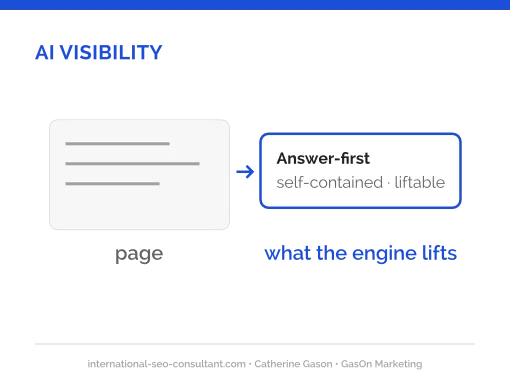
How to make your content extractable for AI
If an engine can't lift a clean answer from your page, it cites one it can.
Read AI Extractability · Content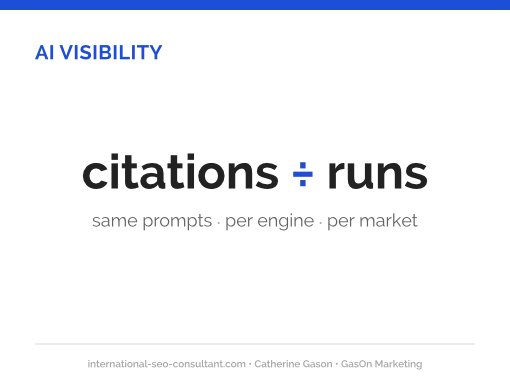
How to measure your AI Visibility Rate
A fixed prompt set, scored per engine and market, turns visibility from a guess into a tracked rate.
Read AI Visibility · Measurement