
AI Visibility • Mechanism
How to make your content extractable for AI
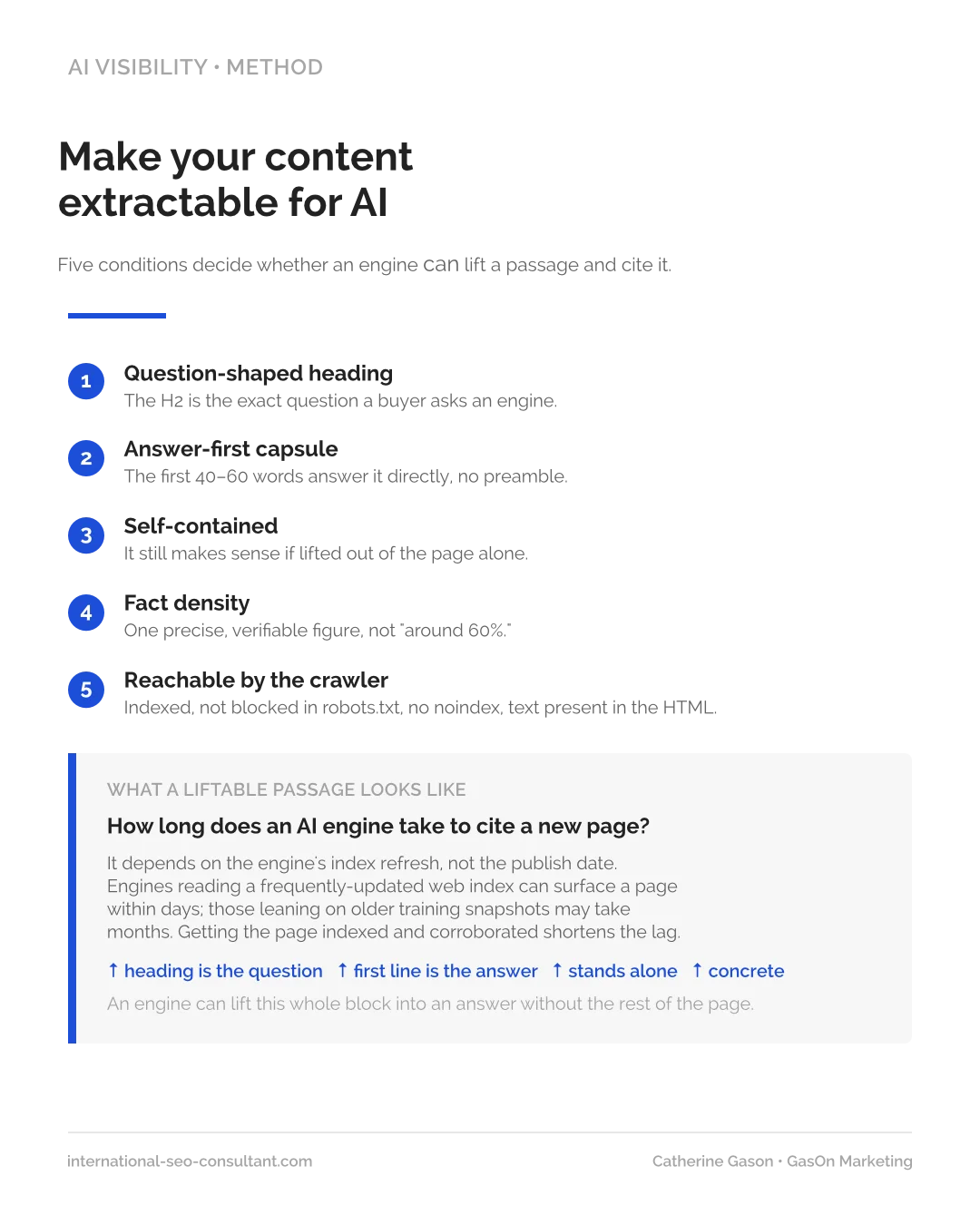
An engine cites the passages it can lift cleanly and skips the rest. Five conditions decide whether a passage gets quoted or passed over.
What makes a page easy for an AI engine to lift and cite?
Content is extractable when a passage can be lifted whole and still make sense. Five conditions make that possible: a question-shaped heading, an answer-first capsule of 40 to 60 words, self-contained phrasing, one precise verifiable fact and a page the crawler can reach. Miss one, and the engine has nothing clean to build its answer on.
Question-shaped heading
The H2 is the exact question a buyer asks an engine
Engines match headings against queries. A heading that is the question itself matches directly; one written for style gives the engine less to match on.
Answer-first capsule
The first 40 to 60 words answer it directly, no preamble
The engine reads the opening of a section as its answer. Anything placed before the answer pushes it out of reach.
Self-contained
It still makes sense if lifted out of the page alone
The passage has to survive on its own, without depending on the paragraphs around it or on what the heading above it implied.
Fact density
One precise, verifiable figure, not “around 60%”
A checkable figure gives the engine something it can confirm against another source. A general claim gives it nothing to confirm.
Reachable by the crawler
Indexed, not blocked in robots.txt, no noindex, text present in the HTML
If the crawler never reaches the text, none of the other four matters.
The mechanism, in detail
What does “extractable” actually mean to an AI engine?
Extractable means a passage can be pulled out of the page and used as the answer without anything else around it. Engines don’t cite whole articles; they build answers from the cleanest passages they can find. If a paragraph only makes sense after the ones before it, the engine can’t use it alone and takes one from a page where the answer stands by itself.
Why must the heading be a question and the first line the answer?
Engines match a heading against the user’s query, so a heading phrased as the buyer’s exact question matches far better than a clever one: “How long does an AI engine take to cite a new page?” rather than “The indexing lag problem.” Once the passage is retrieved, the engine wants the answer straight away, so the first 40 to 60 words should answer the question in full. Any preamble pushes the answer out of reach.
How much does one precise fact matter?
A single verifiable figure turns a passage from opinion into evidence. “Around 60%” gives an engine nothing it can stand behind; “92.3% of Llama 3.1’s training data is English” gives it a concrete claim with a source attached. A precise figure can be checked against other sources, and engines prefer to cite statements they can confirm.
What has to be true before an engine can read the page at all?
Reachability comes first. Before the other four conditions can help, the page has to be indexed, not blocked in robots.txt, free of noindex and have its text in the HTML the server returns. Google renders JavaScript; the main AI crawlers, GPTBot and ClaudeBot among them, fetch the HTML without executing scripts, so text that appears only once a script has run can be invisible to them.
How is writing for AI extraction different from writing for search rankings?
Ranking aims a whole page at a query; extraction aims one passage at being lifted into a generated answer. They overlap in clean structure, but they reward different things: ranking rewards relevance signals spread across the page, while extraction rewards a single passage that resolves one question on its own. Writing for extraction means shaping the passage, not tuning the page.
More in AI Visibility
The other guides in this section, each answering its own question.
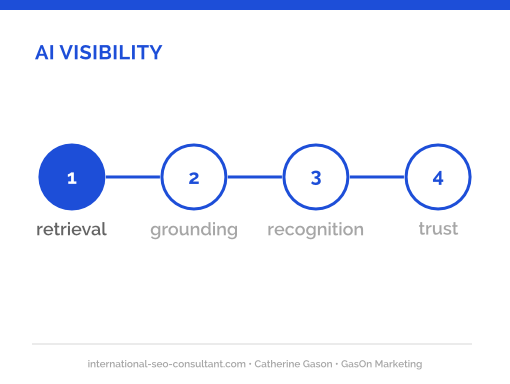
How AI engines choose which brands to cite
A brand clears four gates to be named, and ranking only clears the first.
Read AI Citations • Selection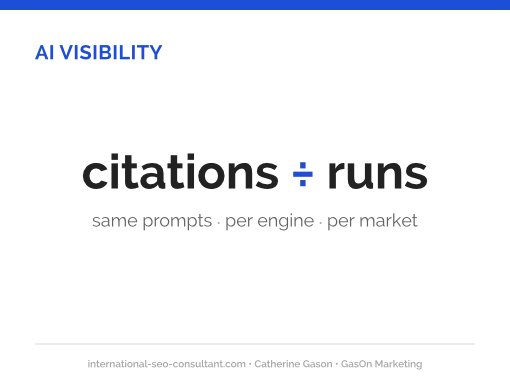
How to measure your AI Visibility Rate
A fixed prompt set, scored per engine and market, turns visibility from a guess into a tracked rate.
Read AI Visibility • Measurement