
Search Everywhere Optimization · Mechanism
Search Everywhere Optimization: a practical guide
Buyers no longer search in one box. Visibility now means presence across Google, AI answers, social search and marketplaces, and each surface rewards something different.
What is Search Everywhere Optimization in practice?
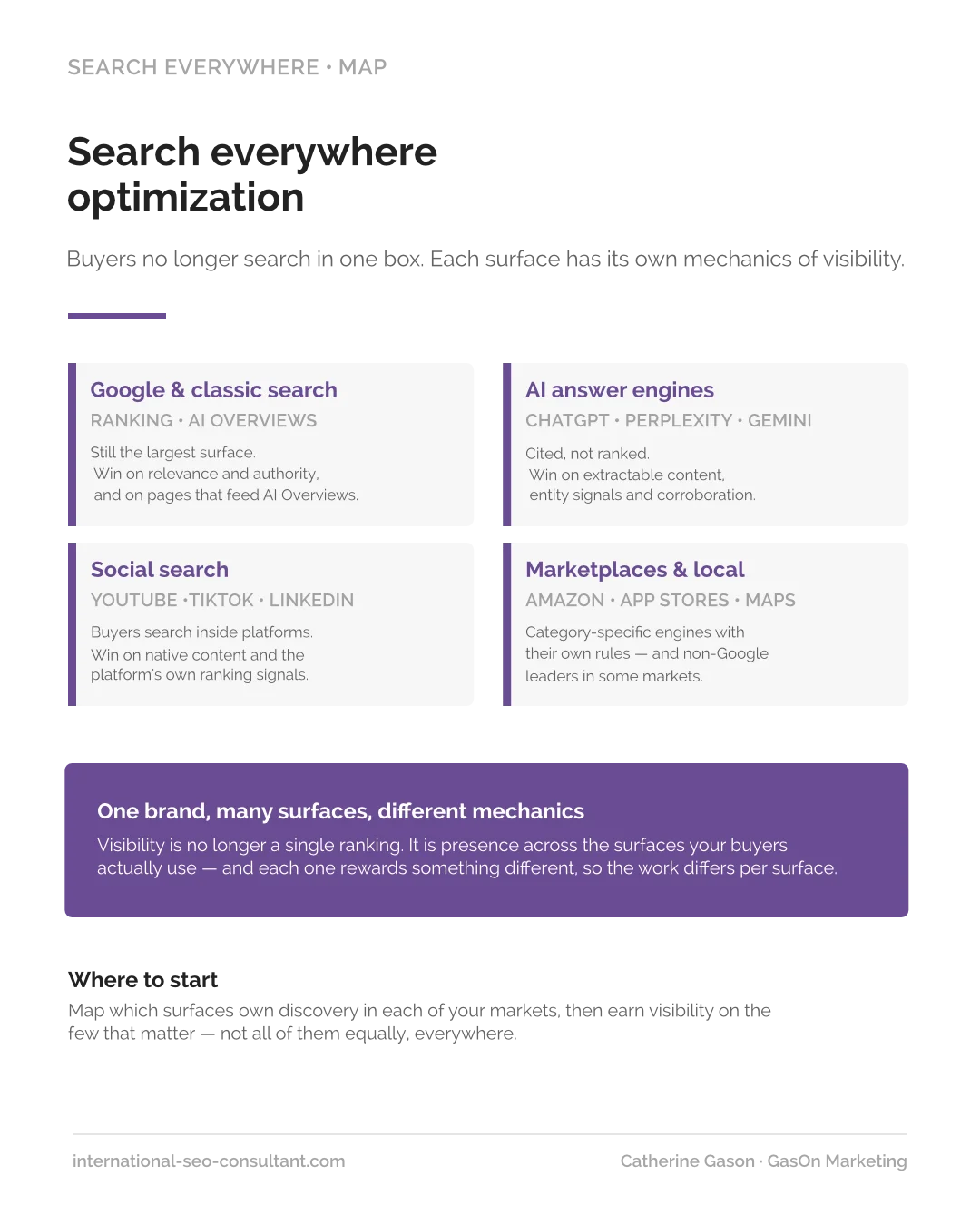
Search Everywhere Optimization is optimizing for the several surfaces buyers now use rather than Google alone: classic search and AI Overviews, AI answer engines, marketplaces or local engines and social search inside platforms. Each rewards something different, so the work is finding which surfaces own discovery in a market, then earning visibility there.
Google and classic search
Ranking · AI Overviews
Still the largest surface. You win on relevance and authority signals, and the same systems decide which pages feed AI Overviews.
AI answer engines
ChatGPT · Perplexity · Gemini
Cited, not ranked. You win on extractable content, entity signals and corroboration across independent sources.
Social search
YouTube · TikTok · LinkedIn
Buyers search inside the platforms. You win on native content and each platform’s own ranking signals, which a website cannot earn.
Marketplaces and local
Amazon · App stores · Maps
Category-specific engines with their own rules. In some markets, Google does not own discovery at all. Each runs its own index and its own ranking inputs.
The mechanism, in detail
Why isn't ranking on Google enough anymore?
Because a single decision now runs across several places. The same person might ask an AI engine, search inside YouTube or LinkedIn, check a marketplace and use Google, often at different stages of the same decision. A brand visible only in classic Google rankings misses the moments that happen elsewhere. Search Everywhere Optimization treats discovery as distributed, not concentrated in one box.
How do the mechanics differ between Google and AI answer engines?
Google rewards a page: relevance and authority signals decide ranking, and the same systems now select what feeds AI Overviews. AI answer engines reward an entity: they cite rather than rank, choosing brands that are extractable, recognized and corroborated. The same content can win on one and not the other: Google is choosing pages to list; an AI engine is choosing brands to name.
What does social search require that classic SEO does not?
Social search happens inside platforms, where buyers query YouTube, TikTok or LinkedIn directly. Winning there means content made for the platform, not links back to the website. Each platform ranks its own library by signals a website cannot earn: watch time, saves, comments and recency.
Where do marketplaces and local engines fit?
They are category- and market-specific discovery engines with their own rules. Amazon for products, app stores for apps, Maps for local. In some markets Google does not own discovery at all, as in South Korea, where buyers search on Naver. Each runs its own index and its own ranking inputs, so ranking well on Google tells you nothing about visibility on them. Treating them as search surfaces, with their own optimization, is part of being visible where buyers actually look.
How should a brand decide which surfaces to prioritize?
Map which surfaces own discovery in each market, then concentrate there rather than spreading thin across all of them. The mix differs by category and country: one market may run on Google and AI answers, another on a local engine and a marketplace. The work is deliberate: identify where your buyers search in that market, and earn visibility there first.
More in Search Everywhere Optimization
The other guides in this section, each answering its own question.
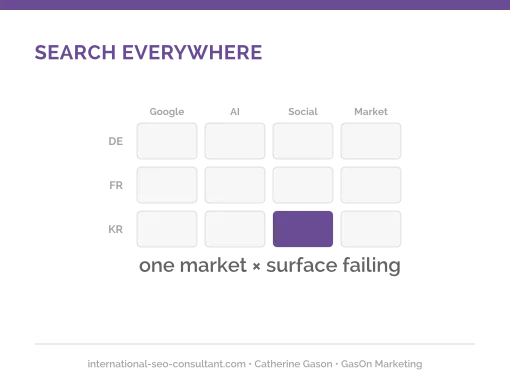
How to measure international visibility, market by market
One global number hides the gaps; a market-by-surface grid shows where you are invisible.
Read Market Visibility · Measurement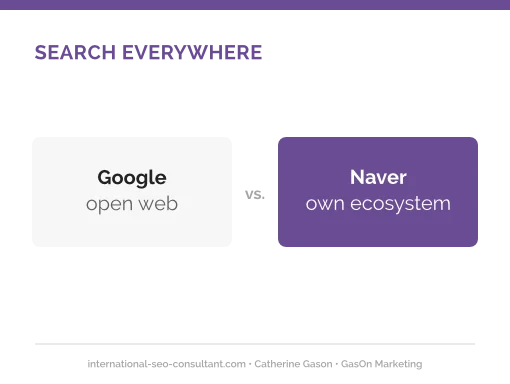
Naver SEO: how South Korea's search engine works
In Korea a Google-only playbook fails, because discovery lives inside Naver's own ecosystem.
Read Naver SEO · South Korea