
International SEO · Mechanism
How to validate international search demand without volume data
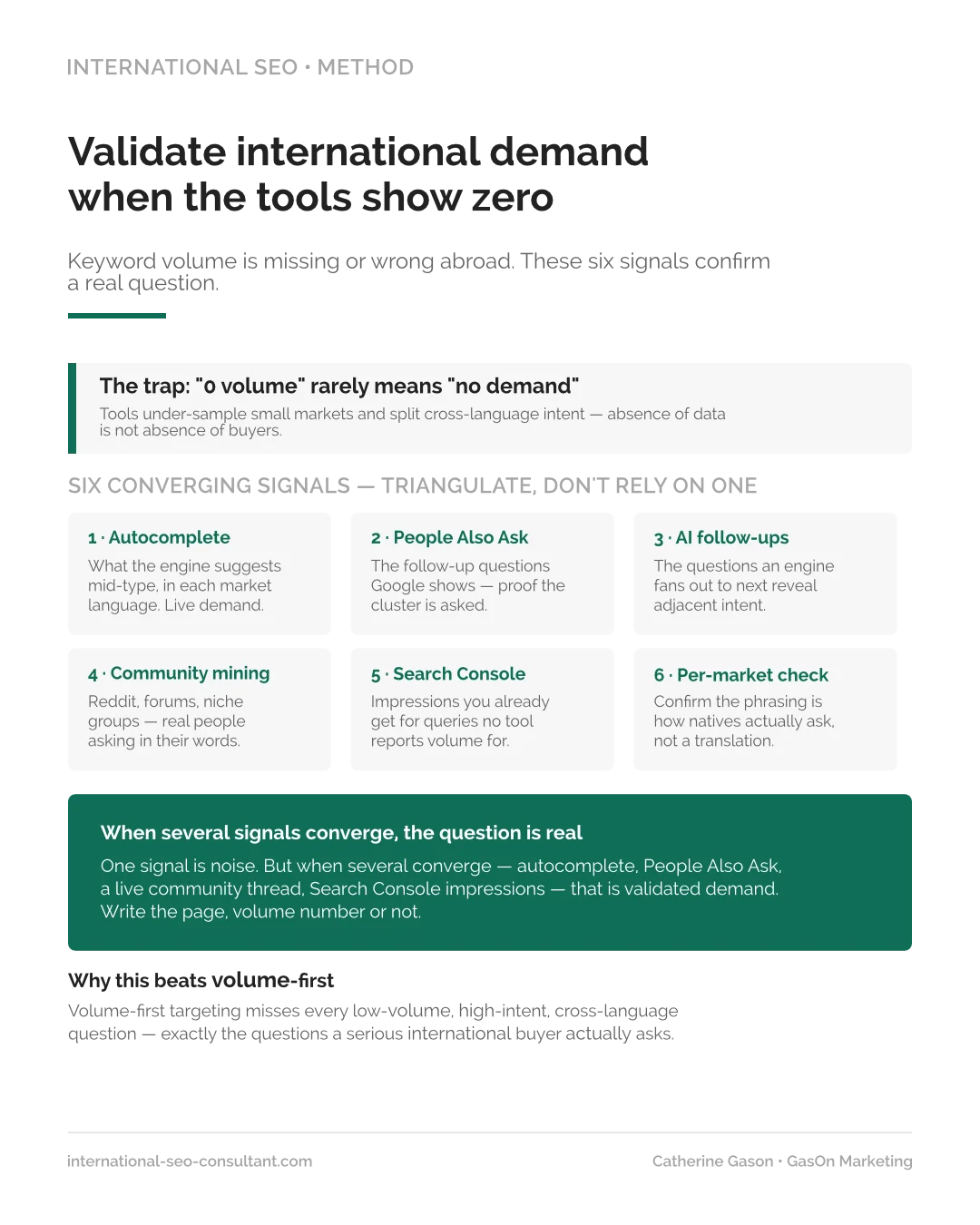
When a keyword tool shows zero, that is missing data, not missing demand. Autocomplete, forums and your own Search Console record the same questions, and where they agree the demand is real.
How do you confirm search demand when the tool shows zero volume?
Validate demand by stacking independent signals rather than trusting a volume number. Check autocomplete, People Also Ask, AI follow-up suggestions, community discussion, Search Console impressions and the phrasing locals actually use. No single signal is proof, but when two or more agree, the question is real and worth a page, even at reported zero volume.
Autocomplete
What the engine suggests mid-type
In each market’s own language. It reflects what people are typing now, not a historical average.
People Also Ask
The follow-up questions Google shows
Proof the engine already treats the question as part of a cluster it answers.
AI follow-ups
The questions an engine fans out to next
They reveal the intent sitting next to yours, and the phrasing the engine expects.
Community mining
Reddit, forums, niche groups
Real people asking in their own words, which is where local phrasing shows up first.
Search Console
Impressions you already get
For queries no tool reports a volume for. This is counted behavior, not an estimate.
Per-market check
How natives actually ask
Confirm the phrasing against the market itself rather than a translation of your English term.
The mechanism, in detail
Why does a keyword tool show zero volume for a question people clearly ask?
Volume tools estimate from historical aggregate data and round low numbers to zero. Low-volume, long-tail, cross-language and conversational-AI-era queries fall below their threshold, so a real but modest question reads as nonexistent. Treating zero as proof of no interest is the core mistake.
What are the strongest signals that a question is genuinely asked?
First-party and engine-native signals. Search Console impressions show the question is already being typed; autocomplete and People Also Ask show the engine itself clustering it; AI assistants' suggested follow-ups reveal the surrounding cluster. These come straight from search behavior rather than a third-party estimate, so they confirm demand the volume tools miss entirely.
How does community mining help validate demand?
If people ask the question in forums, Reddit or trade communities in a given market, the demand is real regardless of what a volume tool says. Community mining surfaces the exact phrasing buyers use and the context they ask in. It is especially valuable for non-English markets, where the local-language version of a question rarely registers in English-centric keyword tools.
Why check per-market language instead of translating the keyword?
Because a translated keyword is often not what locals actually search. Direct translation misses idiom, borrowed terms and the way a market phrases a need. Validating in each market's own language, through autocomplete, communities and Search Console for that locale, confirms the real query rather than an English assumption rendered into another language by a tool.
How many signals are enough before committing to a page?
Two or more that agree, and they have to be different in kind. Autocomplete reflects what has been typed, including by your own team checking the same phrase repeatedly. A single forum thread may be one person in one country. Search Console impressions are real behavior but only cover queries your site already surfaces for, so they cannot validate a question you have no page for yet. Convergence across those different weaknesses is the threshold, not a volume figure.
Does this matter more now that buyers ask AI engines?
More, because the estimate is weaker there. The engines do not publish how often a prompt is asked, so prompt-volume figures are modeled from consented user panels or inferred from clickstream data. That is the same kind of estimate this page warns about, one step further from the source. Questions validated from first-party and engine-native signals are firmer ground, and they become the prompt set you measure AI visibility with.