
Entity Authority • Mechanism
What counts as a citation to an AI engine
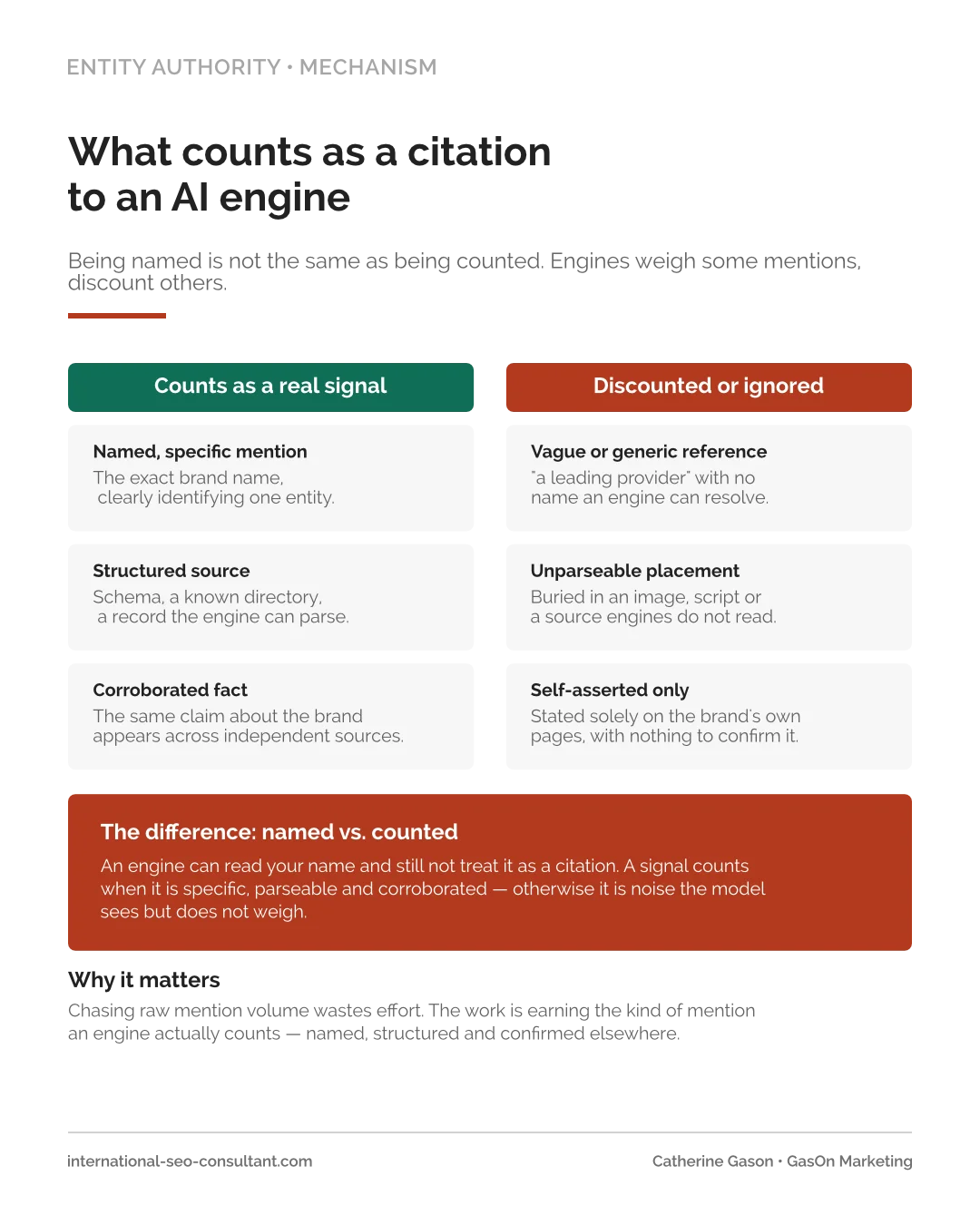
An engine reads many mentions of a brand and counts only some. Whether a mention counts has little to do with how prominent it looks.
What does an AI engine actually count as a citation?
An engine counts a mention when it is specific, parseable and corroborated: the exact brand name, in a source the engine can read, with the claim confirmed elsewhere. It discounts vague references, unparseable placements and self-asserted claims. Being named is not enough: a mention counts only when the engine can tell who it refers to, read it and verify it.
Named and specific
Against a vague reference
The exact brand name identifies one entity. “A leading provider” names nobody the engine can resolve.
Structured source
Against an unparseable placement
Schema, a known directory or a record the engine can parse. A mention buried in an image or behind a script cannot be read.
Corroborated
Against self-asserted only
The same claim about the brand across independent sources. A claim stated only on your own pages has nothing to confirm it.
The mechanism, in detail
Isn’t every mention of my brand a citation?
No. An engine sees many mentions but weighs only some. A citation that builds authority is a mention the engine can link to your brand, read in a source it can parse and, ideally, confirm elsewhere. A passing or ambiguous mention adds nothing the engine can attach to you. Mention strategies tend to go wrong by counting every mention instead of the ones that count.
Why doesn’t a vague reference count?
An engine can only credit a mention it can attach to a specific entity. “A leading provider in the space” names nobody, so the engine has nothing to attach it to, however well the phrase describes you. The same happens when a piece refers to you by a short form or a nickname that doesn’t match the name you use everywhere else.
What makes a source parseable enough to count?
The engine has to be able to read it. A mention in clean text, structured data or a known directory is parseable; one buried in an image, locked behind a script or sitting in a source the engine never crawls is not. A citation that exists only in a form the engine can’t extract is invisible to it, however prominent it looks to a human.
Why does corroboration change whether a claim counts?
A claim stated only on your own pages is self-asserted; the engine has no independent confirmation it is true. The same claim appearing across independent sources is corroborated, and corroboration is what lets the engine treat it as fact rather than as a claim. Counted citations tend to be the ones other sources also support.
What changes in practice?
It changes what you count. Instead of tracking how many mentions appeared, check each one for the exact name, a source the engine can read and a claim confirmed elsewhere. Much of that is fixable after the fact: a publisher can be asked to correct a name, and a claim can be corroborated later. Both are usually quicker than earning a new mention.
More in Entity Authority
The other guides in this section, each answering its own question.
How AI reads brand mentions as entity signals
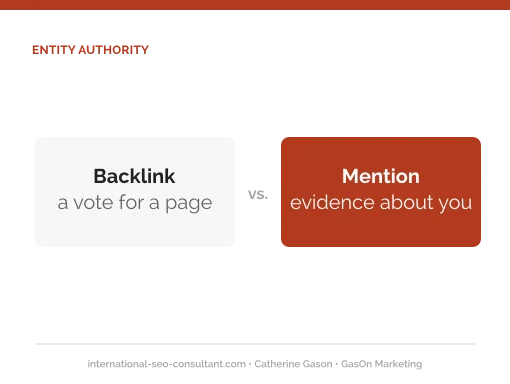
For an engine that resolves entities, a consistent unlinked mention still says who a brand is.
Read Entity Signals • Brand Mentions